PLAY. RECORD. REMEMBER.
Arclight/Matt is the gaming practice of Matt Shadbolt.
Streams, highlights, captures, and writing on games as culture, memory, and systems.
GAMES · STREAMS · CAPTURES · ARTICLES · PATCHES · VAULT
2:32:26 | The past is never buried. It sharpens the blade you carry forward.
Norway again. The return is not nostalgic. The Isu temple underneath the surface of the world turns out to have been there all along, beneath the landscape where Eivor grew up, beneath the mythology she inherited. The past was never sealed. It was waiting.
Basim is about to reveal himself. The session ends on the edge of an explanation that will reframe everything that came before. In Valhalla's structure, the past does not recede. It catches up. It arrives fully formed and asks what you are going to do with it now.
1:36:45 | You are not born a legend; you become one by enduring what others flee.
Sigurd is rescued and he is not the same. The mythology has entered him and he is having difficulty distinguishing it from himself. Eivor watches her brother become something she cannot follow and has to decide whether to hold on or let go.
The Valhalla simulation arrives as a test of exactly this. Endless battle, endless glory, the Viking afterlife as a machine for producing meaning that no longer requires anything real. Eivor sees it for what it is. She has endured enough of the actual thing to recognize the copy.
2:29:40 | A life without struggle leaves no story worth remembering.
Valhalla is two-thirds done and the game knows it. The session has the texture of a story that understands its own shape, the gathering of forces, the approach to a resolution that is still several sessions away. The struggle has accumulated meaning precisely because it has been unrelenting.
What the epigram understands is that the story is the struggle, not the outcome. Ravensthorpe exists because something was difficult to build. The alliances hold because someone paid to maintain them. The life worth remembering is the one that kept going when stopping was available.
2:31:38 | We carry our ancestors forward, whether we honor them or not.
The rescue builds slowly. Eivor calls in the alliances she has spent the game constructing, and each one that answers is a measure of what the settlement has become. Ravensthorpe started as a necessity. It has become a name that means something.
The ancestral weight in this session is about Sigurd as much as lineage. He is Eivor's brother and her king and now her responsibility. What she carries forward is not just blood. It is the obligation to go back for the people who cannot get out alone.
2:24:07 | Faith gives comfort, but it can also demand terrible sacrifices.
Fulke is the clearest expression of Valhalla's religious argument. She is not cynical. She genuinely believes. And her belief has metastasized into something that can justify anything, including what she does to Sigurd. The comfort her faith provides has been purchased by others at a cost she does not have to pay.
Sigurd loses an arm in this session. The vision Valka gave Eivor at the beginning comes true. Prophecy in Valhalla is not a mystery to be solved. It is a preparation for something you cannot prevent.
2:00:48 | Every alliance is forged between hope and inevitable betrayal.
The Sons of Ragnar are figures from a mythology England already knows. Ivar, Halfdan, Ubba. Names that carry weight before they open their mouths. The alliance with them is politically necessary and personally complicated, and Valhalla does not pretend those two things can be fully separated.
Hope is the mechanism that makes alliances possible. You agree to trust someone because you need them and because the alternative is worse. The betrayal comes later, not as a surprise but as a confirmation of what everyone already understood.
1:58:01 | The gods watch, but they do not intervene.
The Asgard sequences ask Eivor to act as Odin and Odin to act as a man. The gods in Valhalla's mythology are not omnipotent. They are frightened. They know what is coming and they spend their divine capacity trying to prevent it rather than accept it. The watching and the not-intervening are two sides of the same helplessness.
Eivor keeps returning from these visions changed in ways she cannot fully articulate. The game does not explain the transformation. It just places her back in England and watches what she does with what she has seen.
43:23 | Peace is promised only after enough blood is spilled.
A short session. The kind that fills the gaps between the larger movements, the administrative work of the campaign, alliances consolidated, loose ends addressed. Valhalla is honest about this texture. Not every session is a turning point. Some are just the work.
The epigram holds even here. Peace as a promissory note, always deferred, always requiring one more payment in violence before it becomes available. The settlement grows. The cost of growing it does not diminish.
2:09:52 | I do not fear death, only dying without meaning.
The Asgard visions arrive properly in this session and the game splits itself in two. Present-day England, ninth-century Norse mythology, Layla Hassan in the twenty-first century. Valhalla has always been asking what meaning survives across time. Now it makes the question structural.
Odin is not a god here. He is a man with foreknowledge of his own death looking for a way around it. Eivor watches from inside his memories and begins to understand that the fear she carries is not hers alone. It is older than Norway. It is older than the blade.
3:42:51 | Hope survives in shattered kingdoms
Clive defeats Ultima. The Crystals are gone. Magic fades from the world. Joshua does not survive to see it. The game ends in a future that is smaller and harder and entirely human, a world that has lost its divine infrastructure and has to figure out what comes next without the aether to fall back on.
Hope survives not as a condition but as a stubborn refusal to accept that the ending is the ending. The final image — Joshua's book, the world Clive fought for, the freedom that outlasted the man who made it possible — is FFXVI's quietest and most considered statement. Shattered kingdoms have survivors. Survivors build things. The game ends before we see what they build, which is exactly right.
1:16:52 | Flames rise when fates collide
Joshua and Clive, Phoenix and Ifrit, two brothers who spent thirteen years believing one had killed the other, finally fighting together toward the same end. The fates that collide in this session are not hostile to each other. They are the same fate, split at Phoenix Gate and reunited here, in a place that exists outside the world they were born into.
The flames are both. Phoenix's light, Ifrit's absorption, the Eikon power that was supposed to doom Clive being the exact thing required to reach Ultima. The game keeps doing this — finding the redemption inside the wound, the specific shape of the damage being the precise tool needed to repair it.
41:10 | A kingdom trembling under forged power
The final approach to Origin. The Metia fragments, the Interdimensional Rift, Ultima in its full expression — the game assembles its last pieces with the clarity of something that has been building to this specific moment for nineteen sessions. The forged power trembling beneath is not just magical. It is the entire structure of the world Clive has been dismantling, now concentrated into a single confrontation.
What makes FFXVI's endgame work is that Clive arrives at it without illusions. He knows what defeating Ultima will cost. He knows what happens to the world when the aether is gone. He chooses it anyway, and the game respects that choice by not softening what it means.
59:17 | Where destiny carves its own path
Ultima wants to use Clive as a vessel, a final Mythos to complete its design and remake the world in a form that excludes humanity. The game's final act is built on Clive refusing this not through superior power but through the completeness of his will. Destiny carves its own path because he keeps insisting on carving it, even when the force trying to redirect him is effectively divine.
The path requires losing things. Dion's sacrifice, Joshua's condition, the cost of every Crystal that has been broken — it accumulates into a world that is genuinely different from the one Clive started in, at a price that the ending does not pretend was cheap.
1:50:15 | A world wounded, a hero awakening
The wound the world carries is not recent. The Blight has been spreading for generations, the Mothercrystals extracting more than they can return, the land dying beneath a civilization that called its own hunger progress. Clive awakening to this is not an epiphany. It is the slow accumulation of everything the game has shown him finally cohering into a direction.
Hero is a complicated word here. FFXVI is careful about it. Clive is not heroic in the sense of being chosen or blessed or narratively protected. He is heroic in the older sense — someone who accepts the cost of the necessary thing and pays it anyway, knowing that what he is paying may be everything.
1:39:05 | Shadows gather as nations ignite
Ultima reveals itself properly in this session, and the game's cosmology becomes fully visible. The Eikons were never random natural forces. They were designed — weapons in a plan that predates the nations that thought they were wielding them. The shadows gathering are not metaphorical. They are the shape of a purpose that has been patient for millennia.
Nations ignite because they are made of people who were told their power was divine and now have to reckon with what it was actually for. Clive stands at the center of this reckoning not as a hero who will fix it but as someone who understands it clearly enough to decide what to do next.
4:15:40 | Honor survives even shattered empires
The Dhalmekian Republic, the Holy Empire of Sanbreque, the Iron Kingdom — they are all versions of the same error. Each built its identity around the Eikon it claimed, the divine power it believed gave it the right to do whatever it needed to do. When the Eikons fall, the empires discover that honor was never in the power. It was in the people who tried to act well within systems designed to reward the opposite.
The longest session in the playthrough. Four hours of an empire in the process of understanding what it was actually made of. Clive moves through it as someone who was shaped by one of those empires and who has been dismantling its logic for the entire game.
1:33:54 | Crystals crack, but freedom rises
The Mothercrystal at Stonhyrr falls. The plan Cid started and Clive inherited is moving forward, and each Crystal that breaks is a small proof that the world's infrastructure is not permanent, not sacred, not inevitable. The people who built their power on Crystal control told everyone it was the natural order. It cracks like anything else.
Freedom in FFXVI is not a condition but a process. The Bearers who are freed when the Crystals fall don't suddenly have a world that welcomes them. They have a world that no longer has a structural justification for their enslavement. What they build with that is the question the game leaves open, the space on the other side of the ending that the player has to imagine.
3:25:17 | A brother’s promise never truly dies
Joshua is the emotional center the game returns to when everything else becomes too cosmic. The two brothers, separated by thirteen years of guilt and grief and misunderstanding, are now working toward the same end, and the promise that structures their relationship is simple: neither of them is allowed to die for the other again.
The game knows this promise will be tested. Everything in FFXVI that is personal eventually becomes structural — the loss of a brother is also the loss of a Phoenix, which is also the loss of a power that could stop Ultima, which is also the loss of a future that might have been possible. The promise never truly dies, but the weight of it keeps growing.
2:48:14 | Revenge burns brighter than any flame
Benedikta is dead. Cid is dead. Hugo Kupka is dead. The game has been burning through its cast with a consistency that feels less like storytelling cruelty and more like an argument: the world built on Eikon power consumes everyone inside it, regardless of which side they stand on.
The revenge Clive carries in this session is not simple. He is not pursuing Ultima because of what was done to him personally, though that is part of it. He is pursuing it because he has finally understood what the Blight is, what the Mothercrystals are for, and what will happen if no one stops the cycle. Revenge, here, is indistinguishable from responsibility.
13:49 | Nobody but me and the horizon.
Sam and the final confrontation, stripped of everything except what he brought in — the skills, the connections, the weight of every delivery made and every strand built. The horizon is not a destination in Death Stranding. It is the permanent proof that there is more world beyond where you are, more to connect, more to carry. The final boss is the game's last argument against nihilism: nobody but me and the horizon is not loneliness. It is the complete description of a person who has accepted the walk.
07:53 | Don’t fall now, Sam. Just keep walking.
The final delivery. The instruction is the series in two sentences — don't fall, keep walking, the complete tactical and philosophical manual for surviving a world in which the floor is always threatening to become a beach. Someone is saying this to Sam, or he is saying it to himself, or it is the accumulated voice of everyone whose strand is in his hands, everyone who needs the delivery to arrive. The walking continues. The game ends with the walking.
04:12 | You’d think by now I’d be used to this silence.
The silence before a BT encounter is the game's most reliable building of tension, and DS2 knows that players who have been through the first game still respond to it viscerally. You would think the familiarity would dull the response. It doesn't, because the silence is the silence of something vast and indifferent registering your presence, and the body never fully convinces itself that this time it will be different.
06:12 | Mountains don’t care if you’re tired.
The terrain in Death Stranding 2 is not antagonistic. It is indifferent, which is worse. The mountain that prevents Fragile from getting to Lou in time is not trying to stop her. It simply exists, with the mass and the gradient it has, regardless of what anyone needs it to do. The exhaustion of the person navigating it is not information the mountain incorporates. This is the specific cruelty of the physical world — it doesn't know you're trying.
02:24 | Step by step, strand by strand.
Lou becoming Tomorrow is one arc. Tomorrow becoming a porter is another — the completion of the inheritance, the child who was carried across America choosing to carry things herself. The series' mantra is in the epigram, the same instructions Sam gave himself across two games now given to someone who learned them by being inside the pod while he walked. She knows this rhythm in her bones before she knows it in her mind.
06:04 | If you could see me now, kid…
Tarman's history lands in this session as the game's acknowledgment that everyone in this world is someone's kid, was once the person someone was hoping to impress or protect or simply not disappoint. The self-assessment is not pride. It is the complicated calculation of a life measured against what someone who loved you would make of it — the specific judgment that is harder than any outside verdict because the judge is someone whose opinion you cannot dismiss.
05:49 | This place eats your mind before your body.
Higgs has been on the beach. What that does to a person is not physical — the body that comes back is intact enough. What it does is reorder the sense of what matters, strip away the social tissue that kept the more dangerous parts of a person in check, leave something that is functionally human but oriented differently, toward different ends. Fragile sees this clearly and acts on it. The place that ate his mind is still visible in how he moves.
07:48 | Still talking to you like you’re here. Maybe you are.
The Death Stranding universe blurs the boundary between presence and absence in ways that make this kind of address possible as more than metaphor. Maybe you are is not wishful thinking in a world where BTs exist, where the beach is a real place, where the dead are not straightforwardly gone. Rainy is talking to someone. The game's cosmology refuses to say definitively that no one is listening.
07:15 | I forget what your laugh sounded like.
Higgs survived the beach and came back changed in ways the game is still mapping. The forgetting in the epigram is the specific forgetting of grief — not the large facts but the sensory details, the laugh, the way someone moved, the particular texture of their presence that no memory can fully reconstruct. Higgs fighting the Red Samurai is spectacle. The epigram underneath it is about someone who is fighting because they have lost something they cannot get back and the fighting is all that is left.
10:24 | Guess I’m the last fool who thinks this is worth it.
Eleven months after the chiral network connected the United Cities of America, Sam Porter (Norman Reedus) lives a secluded life in Mexico with Lou. Fragile (Léa Seydoux) arrives at his home and informs him that she has formed a new company, Drawbridge, which has been contracted by the UCA to extend the chiral network to Mexico. Fragile asks Sam to activate the chiral network terminals BRIDGES left behind in Mexico, just like he did in the United States. Sam agrees on the condition that both he and Lou be pardoned by the UCA, and because his route will take him to a lab where Deadman (Guillermo del Toro/Jesse Corti) works.
He leaves while Fragile takes care of Lou. Arriving at the lab, Sam views a recording left behind by Deadman explaining that he had discovered an anomaly in southern Mexico dubbed a "plate gate", which acts as a portal to Australia where other Death Stranding survivors reside. In addition, Deadman found out that for unknown reasons, Lou was assigned a BB ID number that belonged to an already decommissioned BB, meaning that Lou is not actually registered in the UCA's system. Furthermore, Deadman reveals his lifespan is running out, and has decided to travel to his Beach. Sam returns home to discover that it had been assaulted by an unknown armed group.
While Fragile managed to survive, Lou was killed. One month later, Sam continues to grapple with Lou's death when he is invited by Fragile to board her ship, the DHV Magellan, to travel through the plate gate so they can link Australia to the chiral network. On board, he meets Fragile's crew, Tar Man (George Miller/Marty Rhone)[c] and Dollman (Fatih Akin/Jonathan Roumie),[d] Drawbridge's mysterious benefactor, Charlie, and the leader of the Automated Public Assistance Company (APAC), the President (Alastair Duncan). The President explains that by connecting all of Australia to the chiral network, it should activate additional plate gates that will be able to connect all of the world's continents together.
Drawbridge members Rainy (Shioli Kutsuna) and Heartman (Nicolas Winding Refn/Darren Jacobs)[e] join the crew. Sam commences his mission, but is impeded by the apparent return of Higgs (Troy Baker), who commands an army of "ghost mechs" that terrorize the Australian survivors. In addition, Sam is drawn into "tarfall" anomalies where he is forced to fight a spectral soldier named Neil Vana (Luca Marinelli) who apparently has connections to Lou. After his first encounter with Neil, Sam recovers a chrysalis containing a girl Fragile decides to name Tomorrow (Elle Fanning). Sam is able to defeat Neil permanently.
Neil gives him a memory device left behind by Sam's late wife Lucy (Alissa Jung). The data inside explains that Lou is actually Sam's daughter who was thought killed along with Lucy in a voidout. As the daughter of a repatriate, Lou was secretly abducted by BRIDGES and designated BB-00, the very first Bridge Baby. However, for reasons unknown, Lou was put into storage until Sam came across her. Neil was a smuggler who helped smuggle braindead pregnant women from Mexico into the UCA to meet their demand for BBs.
He happened to be a childhood acquaintance of Lucy and attempted to help her and Lou escape from BRIDGES. Meanwhile, Higgs lays siege to the final network hub needed to complete the Australian chiral network. Sam and Drawbridge fight their way through Higgs' mechs and activate the hub, completing the chiral network. The President betrays Drawbridge, revealing that he is in fact an amalgamation of four thousand human souls connected to APAS. He explains that he intends to use the expanded chiral network to forcibly seclude all humans away in their Beaches to completely negate the risk of encountering BTs, thus protecting them from the Death Stranding.
He adds that he brought Higgs back and provided him the ghost mechs to act as a threat that would force Australia to adopt the chiral network for protection. Charlie then reveals himself as Die-Hardman (Tommie Earl Jenkins), and explains he was already aware of the President's plans and secretly reprogrammed Sam's Q-Pid so that The President can be disconnected from APAS and the chiral network, removing his threat to humanity.
Highlights /Assassins Creed Mirage
1:13:50 | Discipline is your greatest weapon.
The conclusion — Basim completing the work that Mirage set in motion, the discipline Roshan tried to teach finally operational in the precise situation that required it most. The greatest weapon is not the hidden blade or the tools or the network. It is the capacity to act deliberately, to wait for the right moment, to refuse the impulsive choice when the deliberate one is available.
The Basim who ends Mirage is not yet the Basim of Valhalla — there is still centuries of the Isu's work ahead of him — but he is recognizably continuous with that person, shaped by Baghdad and the Hidden Ones into the instrument the game always told us he would become.
2:13:10 | You cannot outrun your past.
Basim's past — the specific thing the game has been withholding, the jinn, the truth of what he carries and what it means. The past he cannot outrun is not his history in Baghdad or his time with the Hidden Ones. It is older than both, written into something the Brotherhood does not fully understand and Roshan does not know how to address.
Mirage's final movement is the reframing — the game revealing that Basim's story is not the origin story we were watching but the earliest visible evidence of something that was already ancient when he was born. The past that cannot be outrun has been running alongside him since before he had a name for it.
3:08:46 | The Creed guides us.
Three hours — the accumulated force of the investigation approaching its targets. The Creed as guide rather than law is the mature version of the philosophy Basim has been learning — not the prohibition-based reading (nothing is true, therefore nothing is forbidden) but the directional one: the Creed points toward the action that preserves human freedom, and Basim is using it to navigate toward the Order's heart.
The guidance has been tested throughout Mirage — by Roshan's instructions, by the Brotherhood's requirements, by Basim's own impulses. This session is the Creed as compass rather than cage, the philosophy functional rather than theoretical.
8:21:01 | Trust is earned, not given.
Eight hours — the longest session, the game at its full depth, the investigation threading through Baghdad's political and criminal underworld. Trust as earned rather than given is the operational principle of the Hidden Ones: the Brotherhood cannot function on blind loyalty, the hierarchy must justify itself through demonstrated commitment rather than assumed authority.
The session is the game's investigation reaching its most complex phase — the targets nested within the institutions that protect them, the trust relationships that shield the Order from exposure. Basim earning his way through those relationships, one contact at a time, is the session's structure.
1:28:35 | This city remembers everything.
Baghdad as archive — the Round City holding the accumulated knowledge of the Abbasid world, the House of Wisdom representing the belief that civilization advances through the preservation and transmission of knowledge. The city remembers because it was built to remember, because the caliphate understood that what you keep is what you are.
Mirage is the most explicitly historical AC game in some time — the recreation of ninth-century Baghdad is the game's most ambitious visual achievement, and this session is deep enough into it to feel the accumulation. The city remembers what the Order is doing to it. The city remembers what the Hidden Ones are trying to prevent.
1:57:21 | You act without thinking.
Another instruction — this time the accusation that follows the consequence, the moment where Basim's impulsiveness produces the wrong result at the wrong time. Acting without thinking is the young assassin's original sin: the gift of capability without the discipline of restraint, the ability to do things before understanding why they should be done.
Nearly two hours of Basim's education in what the Order is and what dismantling it requires. The acting-without-thinking is the session's texture — the choices made in the field that depart from the plan, the results that require recovery. The Brotherhood is teaching him something he does not yet know he needs.
4:24:55 | Power reveals who we truly are.
The Order of the Ancients and what it does with power — the corruption that the game diagnoses not as the exception but as the rule, the way power becomes self-justifying, the way people who began with genuine beliefs become the thing they were fighting. Basim moving through Baghdad's power structures is the game making this argument from the inside: you cannot understand what power does to people without entering the spaces where power is exercised.
The revelation it produces is about Basim too. What the hunt for the Order reveals about who he truly is will not be legible until Valhalla, but the seeds are here — the drive, the specific shape of his grievance, the thing underneath the Creed loyalty that has its own agenda.
44:39 | You must learn patience, Basim.
Roshan says this. It is the game's central instruction and its central irony, delivered to someone who will become one of the Creed's most patient and dangerous agents — but not yet. The young Basim is impulsive, gifted, motivated by something the Brotherhood cannot fully see. The patience Roshan is teaching is not temperamental but operational: the patience of the assassin who waits for the right moment rather than the available one.
Forty-four minutes — one of the shorter sessions, the lesson still in progress. Basim is learning. The session documents the learning rather than its completion.
4:15:58 | The Hidden Ones work in the shadows.
The Brotherhood's induction — Basim becoming one of the Hidden Ones, the precursor organization to the Assassins proper. The shadows are both tactical and ideological: the Hidden Ones operate without visibility because visibility is vulnerability, because the Order of the Ancients controls the visible world and the only way to work against that control is from beneath it.
Mirage is a deliberate return to the series' original register — smaller scale, more focused, the parkour and the assassination rather than the open-world RPG. The Hidden Ones working in shadows is the game's design philosophy applied as narrative: this is not a story about the world-historical sweep of Basim's eventual destiny. It is a story about a young man learning what the shadows require.
57:23 | Nothing is true. Everything is permitted.
Basim Ibn Ishaq in ninth-century Baghdad — the young thief who will become the Assassin we met in Valhalla, the game reaching back to show the origin of someone the earlier game revealed as something far more complicated. The Creed's founding statement lands differently in Mirage than in any other AC game because we know where Basim ends up. Nothing is true is the philosophy. Everything is permitted is the warning. The session is the beginning of the education that will produce the man we already know.
Baghdad at its Abbasid peak is the game's most formally considered setting in the series — the Round City, the House of Wisdom, the specific texture of the world's most advanced civilization at its height. Basim moves through it as a thief first, as an initiate second, and the distance between those two identities is where the game's first session lives.
Highlights /The Last of Us Part Two
10:57 | Some days, I don’t remember why I fight. I just know I can’t stop.
The farmhouse. The guitar. The fingers that can no longer play it. Ellie sitting with everything that is gone — Dina, JJ, the life that was possible, the music that was possible, the Joel that was possible and then was not. The not-stopping is not hope, exactly. It is the survival instinct stripped of all justification, the body continuing because the body continues, the self remaining even after the reasons for the self to remain have been removed one by one.
The Last of Us Part II ends here and does not offer resolution. It offers only the fact of continuing, and it leaves open whether that fact is enough. Ellie leaves the farmhouse. The door stays open behind her. The game has the honesty not to show where she goes.
49:06 | It’s hard to mourn someone when hate keeps you company.
She lets them go. Abby and Lev disappear into the water. The hate that has kept Ellie company since Wyoming is suddenly without its object, and what it leaves behind is not peace — it is the space where mourning would live if there were room for it. The hate was not a replacement for grief. It was a postponement. Now the grief is available and she is alone with it.
Mourning Joel was never possible while the hate was present, because the hate required Joel's death to remain a wound rather than a loss. A wound you tend. A loss you carry differently. The game ends with Ellie learning the difference, which is not the same as the game providing comfort. It is just the truth of where she is.
39:21 | What’s the point of love, if it just gives you more to lose?
Lev. Abby's face. The thing that stops Ellie's hand. The point of love, the game suggests, is exactly this — not the happiness it provides but the anchor it creates, the specific person who makes the choice visible as a choice rather than an inevitability. Ellie sees Lev and sees what she had and gave away, and the love that gave her more to lose is also the love that makes her capable of the thing she is about to do.
The question is not rhetorical. The game is asking it genuinely and answering it with the action rather than the words. The point of love is that it keeps being the point even when it has only cost you things. It is the specific form of meaning that does not require being painless to be real.
8:51 | Sometimes surviving feels like betrayal.
Ellie has Abby. She can end it. The survival of one of them will feel like a betrayal of something — of Joel, of the purpose, of the version of herself that left Jackson certain of what this was for. The game sits here for a long time, in the space before the choice is made, because the choice is not obvious and the game refuses to pretend it is.
The betrayal surviving implies is not of the dead. The dead are past betrayal. It is of the self that needed the purpose to keep moving, the self that organized an entire identity around the pursuit and now has to exist without it. Surviving past the reason for surviving is its own kind of loss.
15:42 | The apocalypse didn’t kill us. We did.
The beach confrontation, approaching. Everything the game has built is converging on this point — two women, both diminished by what they came here to do, both standing in the wreckage of what the pursuit of revenge produces. The Cordyceps did not generate this scene. Human beings did. Human choices, human grief, human loyalty, human violence.
The apocalypse is the context. The killing is the content. The Last of Us Part II has been making this argument for thirty sessions and does not need to make it again here. It just places the two of them in the water and lets the argument be present in what has already been shown.
28:21 | Loyalty is dangerous. It's how good people become bad ones.
The Rattlers as an institution. The WLF. The Seraphites. Jackson itself, at its edges. Every organization in The Last of Us Part II is a study in how loyalty — a genuine virtue, a genuine human need — becomes the mechanism by which good people are moved to terrible actions. You do not need monsters. You need people who love each other enough to do what the group requires.
Ellie's loyalty to Joel is what brought her to Seattle. Abby's loyalty to her father is what brought her to Wyoming. The loyalty is real in both cases. The game does not question the love that generated it. It questions what loyalty demands when it is allowed to operate without the counterweight of other things.
18:41 | I didn’t lose myself. I gave myself away—piece by piece.
The Rattler camp. Ellie finding Abby and Lev imprisoned, surviving in the worst conditions the game presents. The giving away has been voluntary throughout — this is what the epigram insists. She was not robbed of herself. She surrendered pieces of herself in exchange for forward motion, for the continuation of the purpose, for the promise that the next step would be the one that resolved it.
By this point the transaction has been fully completed. What she has given away cannot be accounted for by pointing to a single moment. It was the incremental negotiation of every session, the small payments that accumulate into a total that cannot be recovered.
31:34 | Some roads don’t take you home. They just take you further from yourself.
Santa Barbara. The Rattlers. The road that was supposed to end at Abby ends somewhere else entirely, somewhere that requires more violence, more compromise, more of the self being put in service of a purpose that keeps shifting. Dina is gone. JJ is gone. The home that the farm represented is not waiting.
The road further from yourself is not taken in error. It is the road that the logic of the journey required — each step followed from the previous step, each decision was the next decision in a sequence that began with a reasonable premise and arrived here, in a place that is not home and cannot be made into one.
33:25 | I hated her. I became her. Now I don't know who I am.
The mirroring is complete. Ellie hunting Abby is structurally identical to Abby hunting Joel — the same logic, the same grief, the same conviction that this specific act of violence will resolve something that violence cannot resolve. The game has been building this parallel from the beginning, and by this session it is unavoidable. Ellie has become the thing she hated because hate is not a repulsion from something. It is an obsessive orientation toward it.
Not knowing who you are is the most honest state available at this point in the game. The categories have all dissolved. What remains is the situation, the choice still to be made, the question of whether recognition of the mirroring is enough to break the pattern.
29:47 | They say wounds heal. They never said what they leave behind.
The physical damage of the final sections — fingers lost, the body carrying the record of everything it has survived. But the wounds the epigram is pointing toward are older. The Last of Us Part II has been tracking emotional damage since its first frame, the specific wounds that Joel's death opened in Ellie and Jerry's death opened in Abby, and the game is honest that these do not heal in the way the word implies.
Healing is a metaphor that promises restoration. What actually happens is adaptation — the body and the self reorganizing around the damage, incorporating it, building new structures that can function around the absence of what was lost. The scar tissue left behind is not the original tissue. It is something that has learned to hold.
Vault
7:27 | Choose your fighter, seal your fate
The mobile MK content — seven minutes of the franchise's iOS adaptation, the touch controls and the fighter roster translated to the smaller screen. Choose your fighter, seal your fate is the franchise's defining instruction and its most honest statement about the format: the selection of the fighter is the commitment, the fate determined not by the choice itself but by how completely the player inhabits what they chose.
9:57 | Ride the desert wind toward wonder
The extended run — nearly ten minutes of continuous play, the systems aligned, the combo multiplier building. The long run is the infinite runner at its most expressive: not the learning of the mechanics but the demonstration of their internalized fluency, the body knowing what to do before the mind has processed the approaching obstacle.
1:08:26 | Sand, silence, and the self revealed
The second session — an hour and eight minutes, the full game from the desert through the mountain and beyond, the companion either present or absent depending on the session's network conditions. Sand and silence are the game's materials. The self revealed is what the accumulation of those materials produces: not a plot, not a character, but the specific person who walked this particular path and arrived at this particular end.
32:32 | Walk onward into the waiting light
The first Journey session — thirty-two minutes of the unnamed traveler moving through the desert toward the mountain, the wordless companion mechanics possible but not required. Walk onward into the waiting light is the game's complete instruction and its complete description: the walking is the method, the light is the destination, the waiting acknowledges that the light has always been there and the arrival is a matter of continuing toward it.
0:26 | Eat my goal!
The earliest dated archive entry after the BBC Micro footage — the iPad FIFA from 2014, twenty-six seconds of a goal scored and celebrated. The exclamation is the game's register: the FIFA Ultimate Team format producing the specific joy of the successful combination in the game's most competitive mode. The archive holds this as evidence of where the gaming practice was before it became the site that contains it.
1:03:04 | Every time it does, I wake up here and we go through this all over again.
The time loop game — sixty-three minutes of the reset mechanic, the information that accumulates across iterations, the specific frustration and satisfaction of the loop as both obstacle and tool. Waking up here and going through it all again is the genre's defining experience: the player carrying knowledge the character does not, the death as a tuition payment, the loop as the game's way of extending engagement beyond what a single run could provide.
48:21 | Find the poison. Find the proof. Find the killer.
The Interflix interactive film — forty-eight minutes of the family quiz night that is also a murder investigation, the comedy of the family dynamic against the mystery's growing urgency. Find the poison is the game's procedural instruction. Find the proof is the investigative method. Find the killer is the goal. The three imperatives together are the interactive thriller's complete description of what it asks the player to do.
57:47 | You grip your sword tighter, heart pounding in the gloom.
The complete run — fifty-seven minutes, the dungeon cleared, the jewels insufficient for the victory condition. Completing the dungeon and failing the objective is Deathtrap Dungeon's most honest outcome: the game rewards completion and then tells you what completion was actually measuring. The sword gripped tighter and the heart pounding in the gloom is the game's atmosphere at its most present, the specific somatic experience the text descriptions were designed to produce.
41:39 | A foul stench rises from the black waters as something moves below.
The mobile Fighting Fantasy adaptation — forty-one minutes ending in death, the Rock Grub the proximate cause. The dungeon's atmosphere is the game's strongest quality: the prose descriptions doing the work that the original books did, making the specific texture of the underground spaces present through language rather than graphics. Something moves below is the genre's most reliable threat: the thing you cannot see, in the environment designed to prevent you from seeing it.
1:19:23 | I listen to liars every day. You’re not a good one.
The bio-thriller FMV — seventy-nine minutes of Amy and Rees in the lockdown, the bacterial agent, the corporate cover-up. Listening to liars every day is Amy's professional competence: the virologist who has been working with institutions that manage information rather than share it knows what deception sounds like. Not being a good one is the interactive film's requirement: the player's decisions revealing character in ways that the character tries to conceal.
Archive /Patches
0:31 | We built the future in code and circuits. It responded with silence.
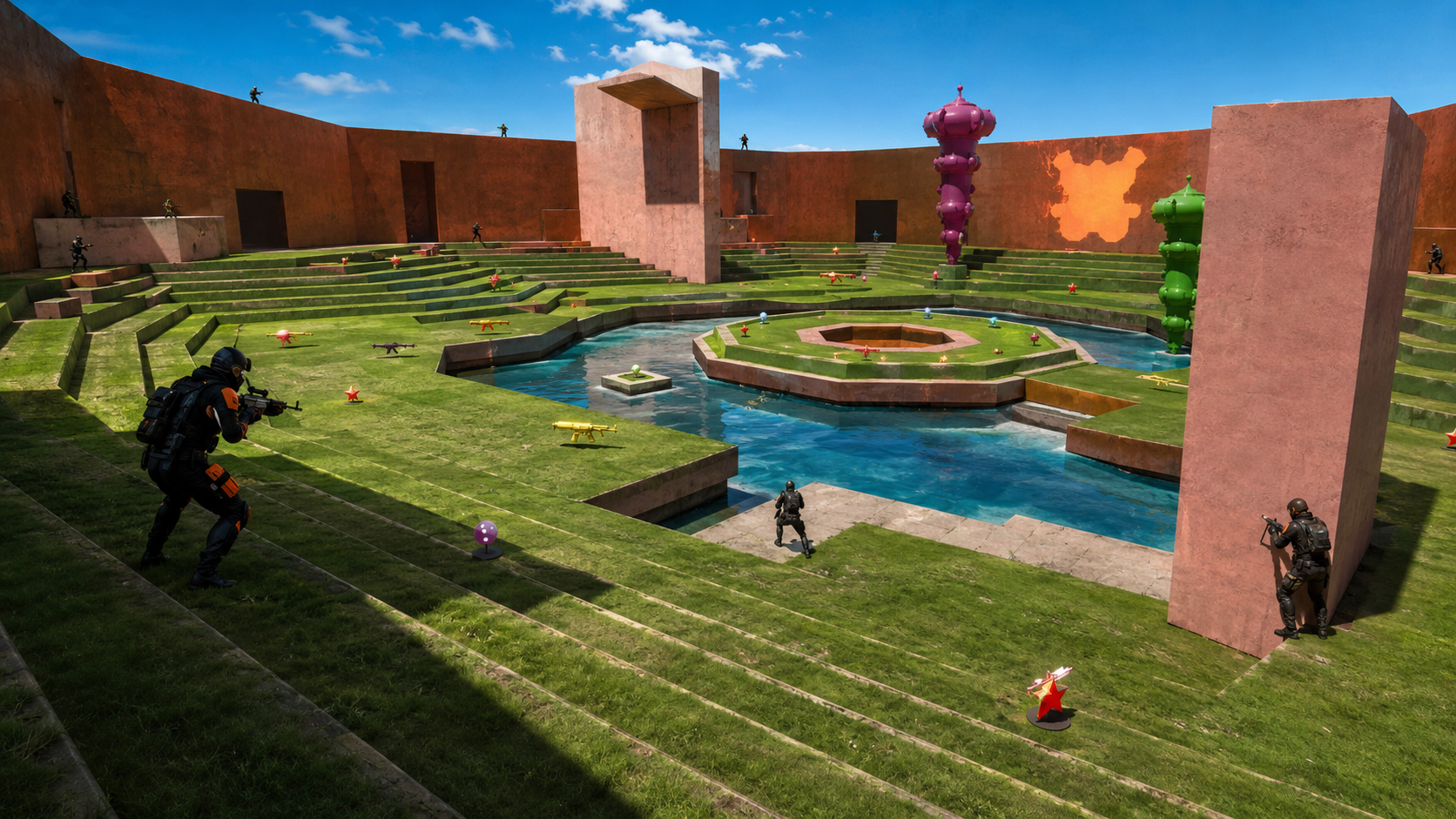
Created for the final Jan van Eyck Akademie Open Days exhibition, Emulation Edition consisted of 12 multiplayer gaming levels, stripped of all realism and reduced down to their core constituent parts, and represented the culmination of all the game design I had worked on during my second year. My end of year show was supported by Apple Benelux and Bungie.
This was one of the projects which contributed to my winning of the 1998 Jan van Eyck Purchases and Collections award, and my work being acquired by the institution for their permanent collection.
0:15 | The AIs don’t sleep. They dream in logic loops and broken protocols.
Created for the final Jan van Eyck Akademie Open Days exhibition, Emulation Edition consisted of 12 multiplayer gaming levels, stripped of all realism and reduced down to their core constituent parts, and represented the culmination of all the game design I had worked on during my second year. My end of year show was supported by Apple Benelux and Bungie.
This was one of the projects which contributed to my winning of the 1998 Jan van Eyck Purchases and Collections award, and my work being acquired by the institution for their permanent collection.
4:50 | You’re not here to survive. You’re here to witness the unraveling.
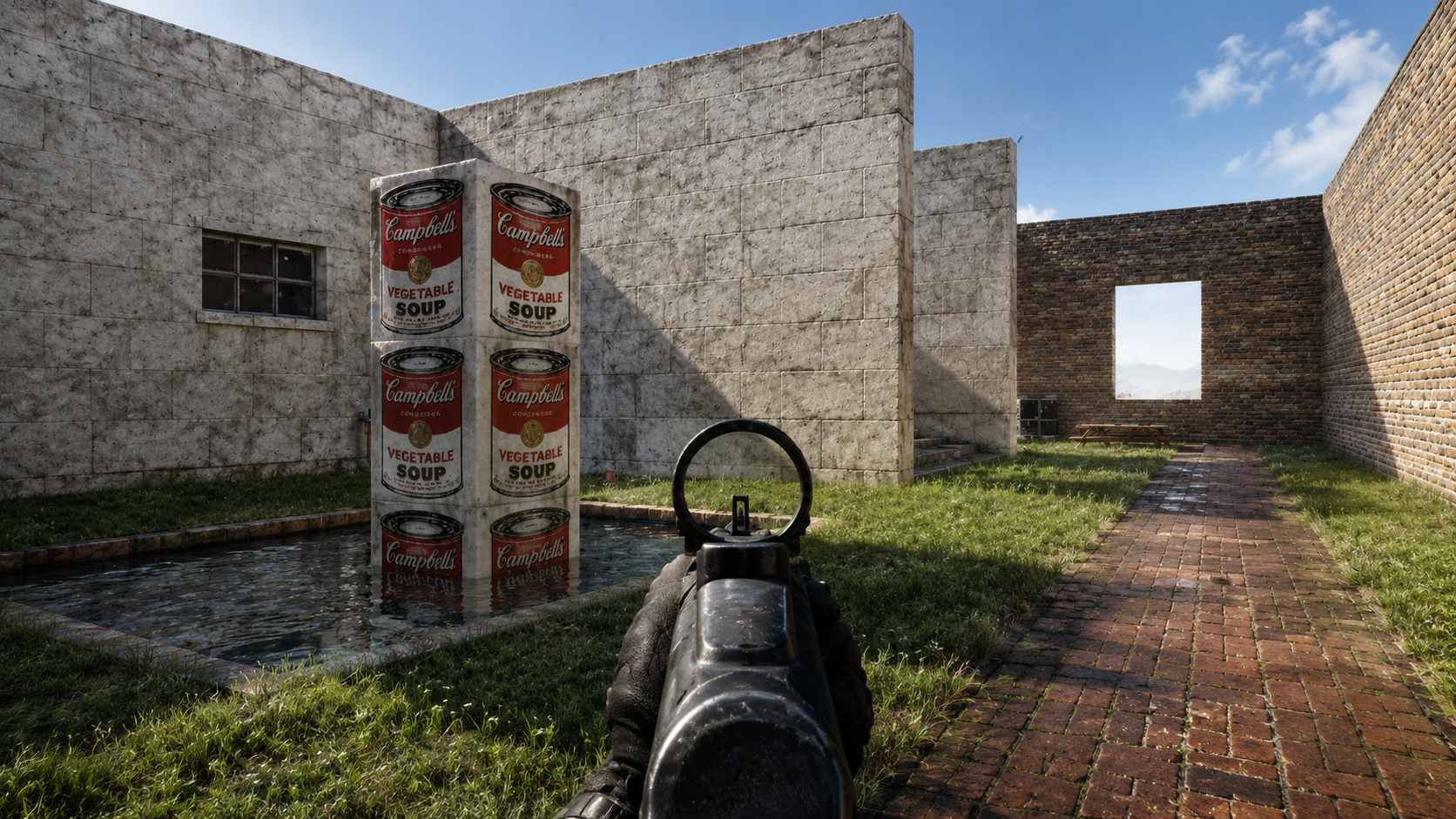
As I deepened my experimentation with disassembling game engines and reassembling them with new and different experiences, I made several versions of Quake, notably taking the idea of applying classic game mechanics to more immersive gaming engines, and simplifying how the user played the game by taking them away from the sense of reality the original game offered.
By the late nineties, games were becoming increasingly realistic, powered by better, faster 3D engines, becoming more complex in terms of narrative, and were moving away from simpler platformers, often to the detriment of actual gameplay. I publicly presented some thoughts on this idea in the form of a talk entitled ‘From Kindergarten to Total Carnage’ at the ISEA98 conference in Liverpool, and at the Stichting de Geuzen in Amsterdam.
I also shared a more comprehensive overview of the current state of game development from a design and user experience perspective for Eye Magazine entitled ‘Live. Die. Eat. Cheat.’ in the Winter 1998 issue (also included in the same issue was my review of Quakeadelica, a London-based multiplayer Quake tournament). With a nod to how I’d eventually start thinking about product development, the notion was ‘how might we apply the gameplay and user experience from a simpler gaming era to modern games in a way which allows users to focus on the challenges, instead of the immersion?’
Quake Radius displayed a fixed, flat base of color around the user, out around them for a specified radius of space during the game. So as you moved through the environment, you could only experience it in terms of the pure, flattened gameplay in your immediate vicinity.
3:35 | The stars were never empty. We just weren’t ready for what filled them.
My first year at The Jan van Eyck had been defined by experiments resulting in CD-ROM production, but during the summer of 1997 I spent 3 months in Phoenix, Arizona where I discovered Bungie’s Forge (map editor) and Anvil (physics editor) engines, which powered their Marathon gaming platform. These tools allowed users to create their own customized environments, sprites, and game design experiments.
They also unlocked the ability for me to take everything I’d been doing with CD-ROM design, and apply it to the mechanics of multi-user interaction in a live environment. My love of Bungie’s products returned much, much later in a different form.
I created a large number of multi-user network gaming environments, including several sprite-based typographic executions. These were all eventually gathered together as a series of custom designed and packaged CD-ROMs.
0:15 | Reality fractures when you stare at it through too much data.
My first year at The Jan van Eyck had been defined by experiments resulting in CD-ROM production, but during the summer of 1997 I spent 3 months in Phoenix, Arizona where I discovered Bungie’s Forge (map editor) and Anvil (physics editor) engines, which powered their Marathon gaming platform. These tools allowed users to create their own customized environments, sprites, and game design experiments.
They also unlocked the ability for me to take everything I’d been doing with CD-ROM design, and apply it to the mechanics of multi-user interaction in a live environment. My love of Bungie’s products returned much, much later in a different form.
I created a large number of multi-user network gaming environments, including several sprite-based typographic executions. These were all eventually gathered together as a series of custom designed and packaged CD-ROMs.


2:34:59 | A home is not found. It is claimed through loyalty, loss, and labor.
Eivor does not discover Ravensthorpe. She builds it, defends it, earns the right to leave it. A settlement she had no intention of founding has become the measure of everything she has done.
The endgame asks something harder. Sigurd unravels. Basim reveals himself. Alfred is spared. The order she fought is not destroyed but redirected. Nothing is resolved cleanly. The game ends the way it began, with someone deciding again what they are willing to carry.